
Pests are part of reef keeping — even a carefully aquacultured, well-quarantined tank can end up with aiptasia, asterina starfish, vermetid snails, or hydroids sooner or later. None of these are usually an emergency, but all of them are much easier to deal with early than after they’ve spread across your rockwork. Here’s what each one actually is and what to do about it.

Aiptasia

Aiptasia is the most notorious pest anemone in the hobby — translucent, brown, fast-spreading, and armed with a sting that irritates or kills nearby coral tissue. It reproduces both sexually and by splitting off fragments, so a single overlooked aiptasia can turn into dozens within weeks. There are three real approaches, and they’re not mutually exclusive.
Chemical Treatments
Products like Joe’s Juice and Aiptasia-X (and similar, including F-Aiptasia) are injected or dabbed directly onto the anemone and kill it within minutes without affecting water chemistry or nearby coral. They work well on aiptasia you can see and reach, but neither kills every larval aiptasia already loose in the system, so new ones can still pop up afterward — chemical treatment handles what’s visible today, not what’s coming next.
Copperband & Other Butterflyfish
Copperband butterflyfish have a reputation as aiptasia eaters, but it’s inconsistent — some individuals go after aiptasia readily, others ignore it completely, and there’s no way to know which you’re getting until it’s in your tank. They’re also a genuinely difficult fish to keep long-term, shy, prone to starvation, and not fully reef safe (clams and feather dusters are at real risk). Treat a copperband as a beautiful, advanced-hobbyist fish that might help with aiptasia as a bonus — not as a reliable aiptasia solution on its own.
Why Berghia Nudibranchs Are the Best Option
Berghia nudibranchs eat nothing but aiptasia — literally nothing else, which is exactly what makes them so effective. Unlike a chemical treatment that only reaches what you can see and reach, Berghia hunt continuously, finding aiptasia tucked into rock crevices and overhangs no syringe ever will, and they consume the entire anemone rather than leaving fragments that can regrow. A tank with a real infestation typically clears out within two to three months of a proper Berghia population being established. The one catch: because they eat only aiptasia, they’ll starve once the job is done unless moved to a new tank with an active infestation, and they don’t survive well in a tank with predators like certain wrasses, shrimp, or crabs that will eat them before they get established. We collect Berghia nudibranchs right here locally in the Florida Keys — if you’re dealing with an aiptasia outbreak, reach out and we can talk through whether they’re the right fit for your tank.
Asterina Starfish

Small, star-shaped, and usually white or tan, asterina starfish hitchhike in on live rock and reproduce both sexually and by splitting, which means a couple can turn into dozens across a rockscape fairly quickly. Most are genuinely harmless detritivores, but some — often the darker ones with red or brown markings — will eat coral tissue, and there’s no reliable way to tell which type you have until you either see damage or don’t. If you spot coral damage that lines up with asterina activity, the most effective targeted control is a harlequin shrimp, which eats nothing but starfish and will systematically clear a tank’s asterina population within a few weeks. The tradeoff is the same as with Berghia: once the asterina are gone, a harlequin shrimp needs another starfish food source (a chocolate chip starfish kept in a refugium works well) or it needs to be rehomed. If you’re not seeing coral damage, many reefers simply leave a light asterina population alone rather than treating a non-problem.
Vermetid Snails
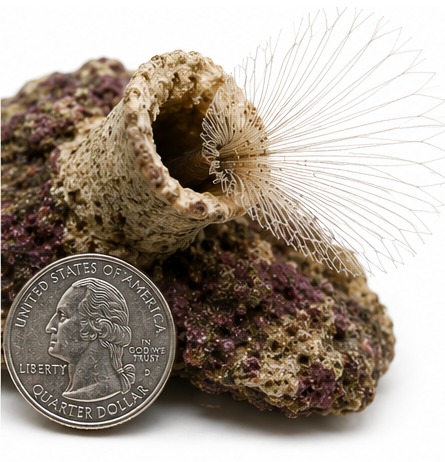
Vermetid snails don’t move once they settle — they build a tube into the rock and cast out sticky mucus nets to catch drifting food, and those nets are the actual problem: they irritate and can damage nearby coral tissue just from contact, and LPS and SPS growth can be impeded where a vermetid has set up shop. Manual removal with a small chisel, bone cutters, or needle-nose pliers works for tubes you can reach; sealing the tube opening with a dab of superglue is a simpler option that starves the snail out over time. Bumblebee snails will prey on vermetids and can help keep numbers down as part of a broader cleanup crew. Cutting back on overfeeding also helps indirectly — less drifting food in the water column means less incentive for the population to expand.
Hydroids
Hydroids show up as fuzzy white or brown growths on rock and glass, related to jellyfish and corals, and they carry a genuine sting that can irritate fish, coral, and your own skin — wear gloves when dealing with them directly. Physical removal is the first move: pull affected rock out of the tank and scrub it thoroughly in a separate container of tank water, being careful not to crush hydroid fragments back into the display, since leftover pieces can regenerate. A hydrogen peroxide dip on affected rock (done outside the main tank) is effective for a heavier infestation. On the biological side, the lynx nudibranch is a dedicated hydroid predator the same way Berghia is dedicated to aiptasia, and some anecdotal reports point to filefish and flame angels picking at hydroids as well, though neither is a guaranteed fix the way a lynx nudibranch is.
Manual removal plus a dedicated predator
Every pest on this list is manageable, and most of them respond best to a combination of manual removal and a dedicated predator rather than one silver-bullet fix. For aiptasia specifically, Berghia nudibranchs are the closest thing to a permanent solution the hobby has — and ours are collected locally, right here in the Keys. Not sure what you’re looking at, or want to talk through a treatment plan? Reach out, or browse our current stock while you’re here.
Quarantine Is Still Your Best Defense
Every pest on this list almost always enters a tank the same way: hitchhiking in on a new coral or piece of rock. A 2-4 week quarantine period for anything new, combined with a proper coral dip before it ever touches your display tank, catches the vast majority of these problems before they become an infestation you’re fighting for months. It’s a five-minute habit that saves you the far more time-consuming work of manually picking Asterina stars off your glass at 11pm.
Shop what you just read about
Aquacultured or conditioned in our Key West systems — FL Cert #AQ0254072. Ships UPS Next Day Air with our live arrival guarantee.
- Clean-Up Crew — 10 in stock, aquacultured or conditioned in our Key West systems
- WYSIWYG Corals — 111 in stock, aquacultured or conditioned in our Key West systems
Read next
Three guides that pick up where this one leaves off.
Coral Pests 101How to identify and treat the bugs actually eating your coral.Read guide GUIDEHow to Dip CoralsThe method, the doses, and why skipping it costs more than the dip.Read guide
 GUIDEAlgae ID GuideHair algae, bubble algae, diatoms, cyano and dinos, told apart properly.Read guide
In stock right now
Quarantined and conditioned in Key West, in stock today. A cleanup-crew pack counts as one item in the box, so it can ride with corals on one shipping charge.
 Scarlet Reef Hermit Crabs – 5 or 10 Pack (Reef Cleanup Crew) Price range: $22.39 through $44.79View this one →
 Florida Fighting Conch (Strombus alatus) Original price was: $19.99.$15.99Current price is: $15.99.View this one →
 Red Spiny Sea Star Original price was: $24.99.$19.99Current price is: $19.99.View this one →
Comments (0)